67 Clicker

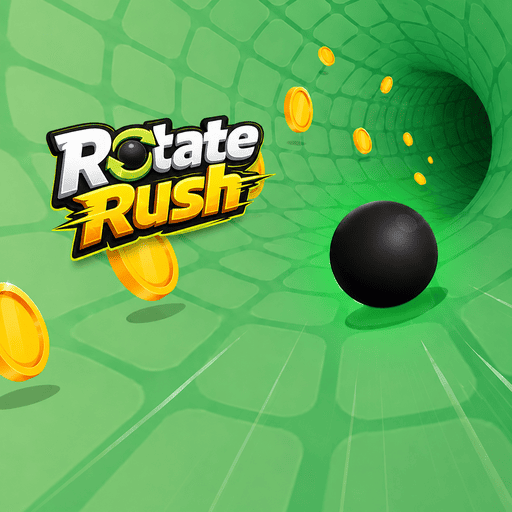
Rotate Rush is a fast-paced reflex arcade game where players control a ball speeding through hazard-filled tunnels, using simple rotation controls to navigate obstacles and reach new score milestones.

Rotate Rush: A Study in Minimalist Arcade Design

The endless runner genre has become one of the most saturated spaces in browser gaming. Thousands of titles compete for attention, most following the same formula: run forward, jump over obstacles, collect coins, repeat. Yet within this crowded landscape, Rotate Rush manages to carve out a distinctive identity through a philosophy of deliberate constraint. Rather than expanding mechanics infinitely, this game distills the endless runner to its most essential form—a single action executed with precision determines whether players advance or fail. This approach raises a compelling question: can meaningful depth emerge from radical simplicity?

The Pillars of Design

Three foundational principles shape Rotate Rush's identity and distinguish it from competitors. Understanding these pillars reveals why the game succeeds where many similar titles falter.

The first pillar is cognitive load management. By restricting input to a single action—rotating right—Rotate Rush eliminates the decision paralysis that plagues complex games. Players engage immediately without tutorials or instruction screens. The entire interface communicates itself through play, which represents a hallmark of excellent game design that respects its audience.

The second pillar is rhythm through escalation. Initial stages feel manageable, almost meditative. Speed increases gradually, transforming this calm into mounting tension. Players experience a carefully constructed emotional arc from confidence to anxiety to triumph or failure. This progression mirrors musical structure, building toward climactic moments before resolution.

The third pillar is the risk-reward tension embedded in every movement. Rotating isn't free—each adjustment commits the ball to a new trajectory. Players must balance the impulse to correct course with the danger of overcorrection. This perpetual negotiation between caution and action creates the game's distinctive tension.

Rotate Rush How It Works

Understanding the mechanics requires examining both the explicit systems and the emergent behaviors they produce. The core objective is straightforward: guide your ball through increasingly difficult tunnels without collision. Movement happens automatically at constantly increasing velocity, eliminating the possibility of standing still or retreating.

The single control—pressing and holding to rotate right—produces surprising complexity through accumulation. Small rotations compound over distance, eventually creating substantial directional changes. Players quickly discover that reactive corrections prove insufficient; successful navigation demands anticipating upcoming obstacles and initiating adjustments well in advance.

Tunnel geometry varies continuously, introducing new challenge patterns throughout each run. Narrow passages demand pixel-perfect timing, while rotating obstacles require players to synchronize their movements with environmental motion. Some tunnels feature speed boost zones that intensify the pace, compressing available reaction time and elevating stakes.

The level design philosophy deserves particular attention. Rather than repeating fixed patterns, Rotate Rush generates procedural variations that ensure no two runs feel identical. Players cannot memorize sequences or develop muscle memory for specific configurations. Each attempt demands fresh attention, preventing the mechanical repetition that exhausts players in traditional endless runners.

Coins appear throughout runs, providing immediate feedback and building toward the daily reward system. These collectibles serve dual purposes: they offer short-term gratification and long-term progression through the unlockables they enable. The balance between immediate reward and delayed gratification keeps sessions feeling meaningful regardless of how far players advance.

Progression and Rewards

Rotate Rush employs a reward structure designed to maintain engagement across multiple sessions. The daily coin system encourages regular return visits, transforming single gameplay sessions into ongoing relationships with the title. Players accumulate currency that unlocks cosmetic variations and functional advantages, providing tangible progression beyond high score chasing.

Critically, the reward philosophy in Rotate Rush separates outcome from compensation. Even failed runs yield some return, ensuring players never feel their time was wasted. This design choice reduces frustration and maintains motivation for subsequent attempts. The psychological principle at work is straightforward: people persist at activities where they experience consistent feedback, regardless of whether that feedback represents "success" by traditional metrics.

Score milestones function as additional progression markers. Each new record establishes a new target, creating an infinite horizon of achievement. The game never truly "completes"—it simply offers increasingly challenging benchmarks for dedicated players to pursue. This infinite design ensures Rotate Rush remains compelling indefinitely, with no ceiling limiting mastery.

Challenge completion rewards add another layer to the progression system. These objectives encourage players to approach familiar content with fresh strategies, preventing the tunnel vision that develops when players optimize for single metrics. By rewarding versatility, Rotate Rush maintains its position as a game worth exploring deeply rather than simply completing.

Genre Position

Rotate Rush occupies a specific niche within the broader endless runner landscape. It shares family resemblance with titles like Geometry Dash and Flappy Bird—games where mastery requires developing intuitive feel for physics-based systems. Unlike those predecessors, Rotate Rush emphasizes tunnel navigation over platform jumping, creating a distinct spatial challenge that tests different skills.

The browser-based presentation carries both advantages and limitations. Immediate accessibility removes friction between desire and play, but the platform historically struggles with depth perception and precise input. Rotate Rush navigates these constraints reasonably well, though occasional misregistrations occur that feel unfair despite being consistent with the game's established rules.

The game's innovation lies in its commitment to constraint. Where competitors add power-ups, character unlocks, and skill trees, Rotate Rush doubles down on mechanical purity. This focus produces a game that feels almost meditative despite—or perhaps because of—its minimalist approach. Players seeking depth through complexity will look elsewhere, but those who appreciate elegant design will find much to admire.

Assessment

Rotate Rush succeeds by knowing precisely what it wants to be. The game doesn't attempt to be everything to everyone—it's a focused experience built around a single compelling idea. The rotation mechanic provides genuine novelty in a crowded genre, and the escalating difficulty creates genuine challenge without requiring external motivation.

Weaknesses remain present though they're more absences than flaws. The minimalist approach naturally limits variety; dedicated players may eventually exhaust the novelty of the core mechanic. The lack of multiplayer functionality or social features means the experience remains fundamentally solitary. These limitations feel less like oversights and more like conscious boundaries the developers chose not to cross.

The ideal player for Rotate Rush appreciates games that respect their time while demanding their attention. Short sessions work perfectly—every run offers complete closure—yet the game rewards sustained engagement through its mastery curve. Players who feel frustrated by complex tutorials or overwhelmed by feature lists will find the accessibility refreshing. Those seeking narrative depth or social interaction should look elsewhere.

Rotate Rush demonstrates that meaningful design doesn't require elaborate systems. Sometimes the most profound experiences emerge from taking a single idea and executing it with exceptional care. In a gaming landscape obsessed with scope and features, this commitment to focus feels almost radical. The game won't appeal to everyone, but for those who connect with its particular wavelength, Rotate Rush offers something increasingly rare: a polished, complete, and genuinely challenging arcade experience that respects both the player's intelligence and their time.

Comments

?

Related Games